
The work itself is the easy part. Here's the order to do the rest.
Costs vary by state. Check yours.
| What | When you need it |
|---|---|
| Registration: LLC, EIN, business bank account | Before the first paid lawn |
| Liability insurance | Before the first paid lawn |
| Mower | Before the first lawn |
| Trimmer and blower | Before the first lawn |
| Trailer | In the first season |
1. Register your business
Pick a name, register with your state (most operators choose an LLC for liability protection), get an EIN from the IRS, and open a business checking account. The whole process takes a couple of evenings. Don't skip the separate bank account. Mixing personal and business money makes taxes painful and exposes your personal assets.
2. Get the right insurance
Liability first, before the first paid lawn. Commercial auto for the truck. An applicator policy if you spray. If you have employees, you also need workers' comp.
3. Buy the right equipment, in the right order
Skip the temptation to buy everything new on day one. The order:
- Mower: A good 21" commercial walk-behind, or a used 36"/48" commercial walk-behind off Marketplace.
- Trimmer + edger + blower: One trusted brand (Stihl, Echo, or Husqvarna) so they share parts and dealer relationships.
- Trailer: 5x10 open utility is enough for the first season; upgrade to a 6x12 enclosed when you're storing equipment indoors.
- Truck: Anything reliable that can pull the trailer. New trucks are the fastest way to break a young business.
4. Decide on pricing
Price from the hour: about $100 per person, with a $50 minimum. Full math: What to charge for lawn mowing. For recurring weekly customers, lock the rate so you can plan revenue, and reprice every year as costs rise.
5. Build a recurring schedule
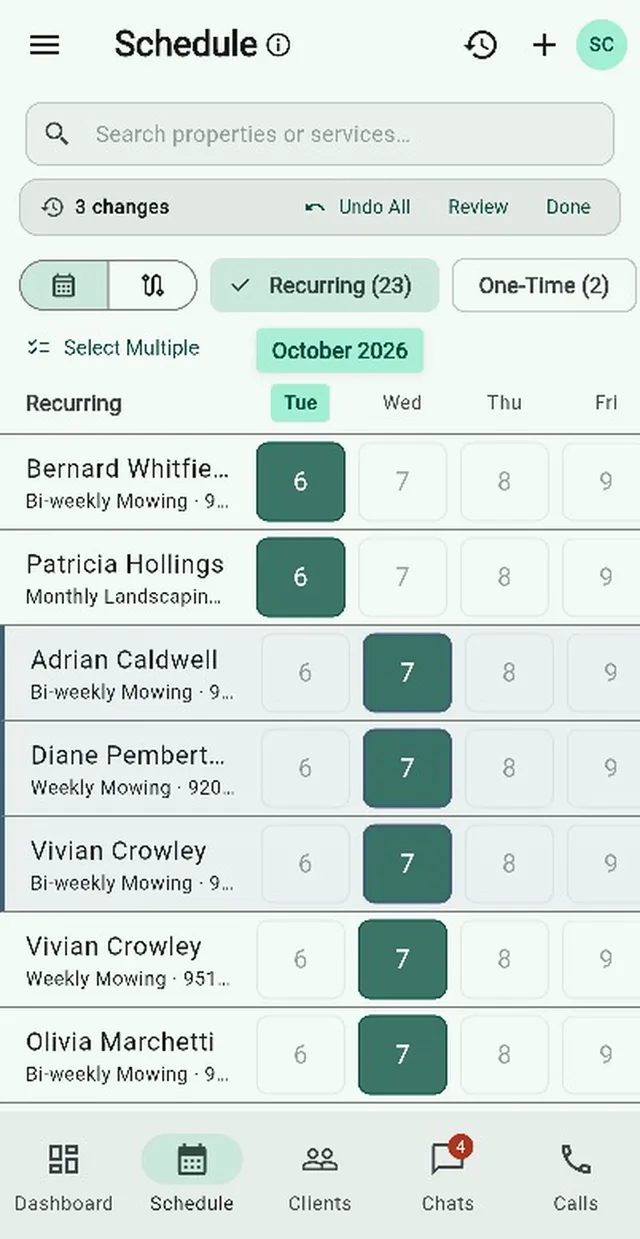
Recurring weekly or biweekly mowing is the financial engine of a healthy lawn care business. One-off cleanups pay the bills, but recurring visits are predictable revenue you can plan around. Aim to fill your schedule with weekly stops within a tight radius. Driving across town between every job kills your margin faster than under-pricing.
Grass Go keeps every weekly stop on one schedule and bills from it. Rained out? Move the day.
6. Find your first 10 clients
The first 10 clients usually come from three sources, in this order: people you already know, neighborhood door-hangers in target ZIP codes, and a basic Google Business Profile with three real photos. Skip paid ads until you have 30+ recurring clients. Referrals are cheaper and higher quality.
A one-page site helps more than ads. Build one free, publish it for $5 a month.
7. Set up payments before you need them
Don't finish the work and then chase payment for two weeks. Set up cards on file from day one. Stripe's 2.9% + 30¢, plus 0.7%, only when a client pays by card. Cash, check, Venmo and Zelle cost nothing. Prices as of Oct 5, 2026. More in Stop chasing payments.
8. Track every minute and every mile
For the first 90 days, write down what time you arrived, what time you left, and how many miles you drove between jobs. After three months you'll have a clear picture of which jobs make money and which ones are quietly losing it. Most new operators find that one or two of their cheapest customers eat an hour of windshield time per visit and need to be repriced or dropped. Grass Go doesn't clock time or miles. A notebook works.
9. Reinvest year one's profit into the business
Better equipment, a second mower so a breakdown doesn't cost you the week, and an emergency fund that covers two months of expenses. Year two is when you start paying yourself.
Where Grass Go fits
Grass Go runs the route: clients, schedule and invoices on your phone, iPhone or Android. Pull clients in from your contacts. It costs nothing to run. Grass Go takes 0.7% only when a client pays by card. The business phone line is optional, at $24.99 a month. See every feature.